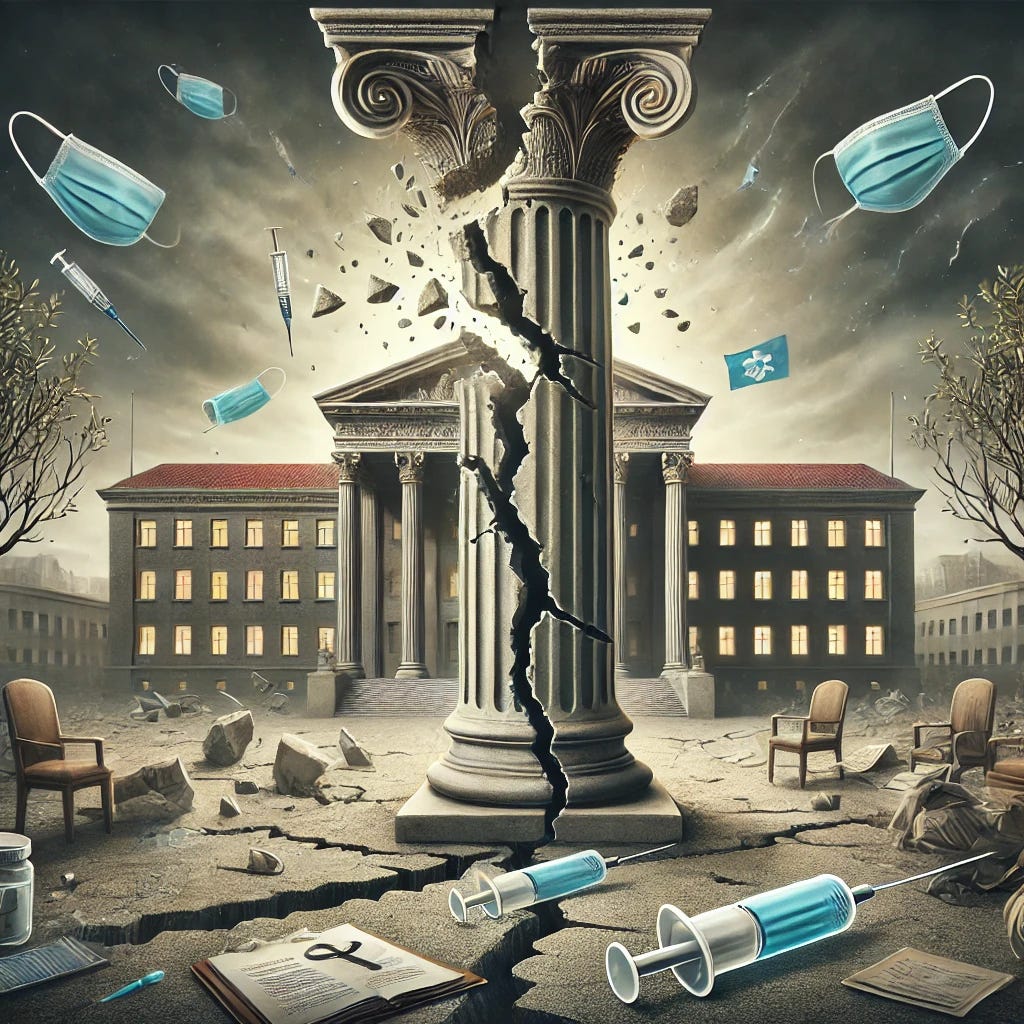
The statistics tell one story about lockdowns - their ineffectiveness, their costs, their fundamental failure as public policy. The numbers are stark: a Johns Hopkins meta-analysis showing a mere 0.2% reduction in COVID mortality (equivalent to an absolute risk reduction of 0.03%), Sweden's superior outcomes despite refusing lockdowns (lowest excess mortality in Europe according to Eurostat's 2023 analysis), and the World Bank's estimate of 70% of children in low-income countries now unable to read a simple text. But numbers, however damning, cannot capture the profound rupture in social trust that occurred when governments worldwide abandoned centuries of accumulated wisdom about both infectious disease management and the foundations of liberal democracy.

Consider the historical precedent: During the 1957-58 Asian flu pandemic, which killed approximately 116,000 Americans (equivalent to 223,000 in today's population), U.S. Surgeon General Leroy Burney explicitly rejected school closures, noting they would "serve no useful purpose." This wisdom, documented in David Henderson's and Jeffrey Tucker's "Liberty After Covid," wasn't mere intuition - it was based on decades of epidemiological observation and respect for societal function. Similarly, during the 1968 Hong Kong flu, which claimed roughly 100,000 American lives, life largely continued without disruption. The Woodstock festival proceeded in 1969 without a single public health official suggesting cancellation.

The conventional narrative suggests we simply need better policies, more transparency, improved communication. But this therapeutic approach to institutional failure misses the deeper wound. When the NIH's leadership orchestrated what they termed a "quick and devastating takedown" of the Great Barrington Declaration - as revealed in Francis Collins' October 8, 2020 email to Anthony Fauci - they weren't merely attacking a document. They were, as Martin Kulldorff later noted in Tablet magazine, declaring war on the very process of scientific discourse itself.
This matters profoundly for my own decision-making going forward. The revelation that the CDC altered its definition of "vaccination" in August 2021 - documented by the Wayback Machine - from "producing immunity" to "producing protection" speaks volumes about institutional flexibility with truth. How much faith should I place in public health pronouncements? When should I trust my own judgment over institutional guidance? The answer, I've concluded, lies in developing what we might call "calibrated skepticism" - neither blind trust nor reflexive rejection, but rather a careful weighing of evidence against an institution's track record and incentive structures.
Consider masks for babies in schools. The evidence for their effectiveness for masks in schools was always remarkably thin - a fact highlighted by a landmark Cochrane Review in 2023, that found "wearing masks in the community probably makes little or no difference to the outcome of respiratory illness compared to not wearing masks." Yet pointing this out, even on babies, became somehow transgressive, as exemplified by Emily Oster's experience at Brown University. Her data-driven approach to school reopening led to what The Atlantic called "pandemic pariah" status among her academic colleagues. https://www.nytimes.com/2021/06/22/us/emily-oster-school-reopening.html

The real question wasn't about the masks themselves, but about our society's capacity to distinguish between science and what C.S. Lewis might have called "scientism" - the elevation of scientific authority to an almost religious status. This phenomenon was presciently described by Richard Feynman in his 1974 Caltech commencement address: "Science is the belief in the ignorance of experts." The pandemic response turned this principle on its head, demanding deference to expertise while actively suppressing scientific debate.
For my own part, this means being more vocal about demanding evidence while nurturing what Hannah Arendt called "the dignity of thinking." When Yale epidemiologist Harvey Risch published his controversial meta-analysis on early treatment protocols in the American Journal of Medicine (January 2021), the ensuing controversy revealed less about the science itself than about our institutions' diminishing capacity for nuanced debate. The episode brought to mind Václav Havel's observation about life in post-truth societies: "The line of conflict runs de facto between a system of rituals and people who are attempting to live within the truth."
Teaching our children about science now carries a deeper imperative. Beyond the standard curriculum of hypothesis and experiment lies a more subtle lesson about institutional fallibility. When Nature published its mea culpa regarding the lab leak hypothesis (June 2021), acknowledging that "for many people, 'trust the science' has become a degraded phrase," it inadvertently provided a teaching moment about the difference between scientific method and scientific institutions.

The great irony of the pandemic response is that by trying to mandate trust, our institutions destroyed it. The University of Chicago's Casey Mulligan and Stanford's Robert E. Moffitt documented in their NBER working paper (2023) that states with more restrictive policies saw greater declines in institutional trust, controlling for mortality rates and demographic factors. Rebuilding this trust requires not just new leaders or better policies, but a fundamental reset in how we approach the relationship between expertise and individual judgment.
This may sound like a counsel of despair, but I find it strangely liberating. Once we abandon what philosopher John Gray calls "the Enlightenment faith in inevitable progress," we can begin the hard work of building more resilient, more honest ways of knowing and deciding. For me, this means embracing what epidemiologist John Ioannidis termed "uncomfortable science" - findings that challenge our preconceptions and force us to revise our understanding.
The implications of this epistemological crisis extend far beyond public health. As we contemplate the future of scientific discourse and institutional authority, we find ourselves at what historian Timothy Snyder might call a "crossroads of memory and responsibility." The Great Barrington Declaration authors - Bhattacharya, Kulldorff, and Gupta - have been largely vindicated by empirical evidence, yet their vindication offers cold comfort in a landscape of fractured trust and tribal certainties.
What remains is a profound challenge: how to reconstruct not just institutional credibility but the very framework of reasoned discourse in a post-pandemic world. The task ahead recalls Isaiah Berlin's distinction between the hedgehog, who knows one big thing, and the fox, who knows many things. Our institutions, in their single-minded pursuit of COVID mitigation, embodied the hedgehog's limitations. The path forward requires the fox's wisdom - an appreciation for complexity, an acceptance of trade-offs, and a willingness to navigate uncertainty with both courage and humility.
As my wife and I prepare for parenthood in this altered landscape, we find ourselves inheritors of a paradoxical legacy. The pandemic response has taught us to question authority more rigorously while simultaneously highlighting our deep need for trustworthy institutions. This tension - between necessary skepticism and essential trust - may well define the next chapter of our collective relationship with science, expertise, and governance.
In the end, the Great Barrington Declaration stands not merely as a document of pandemic policy, but as a testament to what Thomas Paine called "the power of reason and the principle of reflection." Its authors remind us that true science thrives not on consensus but on controversy, not on certainty but on doubt, not on institutional power but on the ceaseless pursuit of truth, however uncomfortable that truth might be.

The challenge now is to rebuild - not the false edifice of unquestioning trust, but something more durable: institutions worthy of trust because they embrace transparency, admit error, and recognize that in the grand conversation between expertise and experience, wisdom often lies in the spaces between.